Benjamin H. Bratton
Platform and Stack, Model and Machine
Platform and Stack, Model and Machine
The goal of future wars is already established: control over the network and the flows of information running through its architecture. It seems to me that the quest for global totalitarian power is not behind us but is a true promise of the future. If the network architecture culminates in one global building then there must be one power that controls it. The central political question of our time is the nature of this future power.
— Boris Groys 1
The essence of datagram is connectionless. That means you have no relationship established between sender and receiver. Things just go separately, one by one, like photons.
— Louis Pouzin 2
9. Platforms
Platforms are what platforms do. They pull things together into temporary higherorder aggregations and, in principle, add value both to what is brought into the platform and to the platform itself. They can be a physical technical apparatus or an alphanumeric system; they can be software or hardware, or various combinations. As of now, there are some organizational and technical theories of platforms available, but considering the ubiquity of platforms and their power in our lives, they are not nearly robust enough. Perhaps one reason for the lack of sufficient theories about them is that platforms are simultaneously organizational forms that are highly technical, and technical forms that provide extraordinary organizational complexity to emerge, and so as hybrids they are not well suited to conventional research programs. As organizations, they can also take on a powerful institutional role, solidifying economies and cultures in their image over time. For The Stack, this is their most important characteristic but perhaps also the hardest to fully appreciate. Platforms possess an institutional logic that is not reducible to those of states or markets or machines, as we normally think of them. They are a different but possibly equally powerful and important form. Many different kinds of systems can be understood as platforms, from urban street grids to Google, and so to consider their common operations, some abstraction is necessary. Part of their alterity to normal public and private operations is the apparently paradoxical way that they standardize and consolidate the terms of transaction through decentralized and undetermined interactions. Platforms can be based on the global distribution of Interfaces and Users, and in this, platforms resemble markets. At the same time, their programmed coordination of that distribution reinforces their governance of the interactions that are exchanged and capitalized through them, and for this, platforms resemble states. Platforms are often based on a physical standardization of functional components that allows for more diverse and unpredictable combinations within a given domain. On the macro scale, the intermixing of public-facing infrastructural investment and oversight tied up with the privatization of existing public services makes the political identity of platforms that much more ambiguous. 3 So long as those exchanges are regularized by passage through the platform ' s established forms, they enforce the optimization of interactions by binding open exchanges between self-directed Users at the edges of its network. When those forms are computational (as for Google), that passage is the capitalized translation of interactions into data and data into interactions, and the movement of these into and out of central locations (such as strongly defended data centers). As we will see, the genealogy of platforms is diverse and seemingly contradictory. Roman urban planners, the encyclopedia of John Wilkins, Charles Babbage, the Commissioners 'Grid Plan of 1811, John Maynard Keynes, Friedrich Hayek, Lady Ada Byron, Vint Cerf, and others, all contribute to the parentage of platforms, and it is their eccentricity and exteriority from normal state and market institutional models, combining elements of these as well as of machine engineering, that has made them so successful in redrawing the effective terms of global systems.
Platforms demand an active conversion between economic and technical systems and their respective limitations. Their initial program may be born of economics, but their execution can push sideways through other models of value, confounding and compressing the political spectrum along with them. Their history bears this out. A working technical definition of platform, in general, may include references to a standards-based technical-economic system that simultaneously distributes interfaces through their remote coordination and centralizes their integrated control through that same coordination.4 I will unpack this definition below. What I call platform logics refers first to the abstracted systems logic of platforms (their diagrammatics, economics, geography, and epistemology of transaction) and second to the tendency on the part of some systems and social processes to transform themselves according to the needs of the platforms that might serve and support them, both in advance of their participation with that platform and as a result of that participation. Platforms provide an armature and induce processes to conform to it. The Stack is a platform, or, more accurately, a combination of platforms. Its own governing logics are derived from platform logics, but its geography and geometry are also peculiar, and so while stacks are platforms, not all platforms are stacks, and in fact most platforms are not stacks.
While systems that arguably operate as platforms might be found in every culture, where does the concept of platform come from, specifically in relation to the development of modern machines? The etymology of platform refers to a " plan of action, scheme, design "and, from the Middle French, platte form, or, literally, a plateau or raised level surface. As Benedict Singleton writes, this conjoined with the plot, which itself first implies a plot of land. Once situated on the platform of the stage, the " plot " becomes a more abstract structure that situates characters into the forgone conclusion of its unfolding, even as they suffer the choices that aren ' t really theirs to make. As Singleton would have it, here the plot is a diagram that ensnares the Users of the platform in its designs. 5 By at least 1803, platform takes on more explicitly political meaning, as in a " statement of party policies. "All three of these connotations (platform as a plan of action, as a stage for a plot, and as proposed rules governance) are important for understanding The Stack as a platform and for platform sovereignty in general. One is set of instructions, one is a situated place where action is played out according to plan, and one is a framework for a political architecture. Already these connotations are slipping and sliding into one another.
Now consider the word program. Its etymology refers first to a " public edict, "and in the early modern era, it also comes to mean variously a plan or scheme, a list of events to be presented, a menu of proposed political ideas, and a way to organize how people will occupy architectural space. Only after World War II does " to program "mean " to write software. "For architecture, computation, and politics, the " program "has central significance as a design problem and governing technique. The triangulation of designed site, designed action, and designed polis traces that of " plot " : platform and program overlay one another asymmetrically. For example, an architectural program might be defined as an intended organization of Interfaces in a particular arrangement so as to coordinate social contact and interaction (or prevent it). As a diagrammatic image, an architectural program indexes the significance of that organization. A software program is a set of instructions that a designer gives to computational systems with the intention of coordinating that system ' s internal and external interfaces in relation to itself, to compatible systems, and to Users. An interfacial image of that program, usually the graphical user interface (GUI), summarizes, reduces, and makes those instructions significant for Users. And clearly today, these two kinds of programs intermingle. In many respects, what society used to ask of architecture — the programmatic organization of social connection and disconnection of populations in space and time — it now (also) asks of software. We will return to that shift more than once in the following chapters, and we will have to question what is or isn ' t the remaining work of physical architecture in light of this. Among what remains is the active contingency of programs, both hard and soft.
A recognition of platforms as a third institutional form, along with states and markets, situates the convergence of its architectonic and computational forms in a more specific and fundamental way. A central argument of this book is that the " political program " is not only to be found in the legal consensus (or dissensus) and policy admonitions of traditional " politics "but also in machines directly. This is where the global-scale arrangement of planetary-scale computing coheres into The Stack, and how the convergence of the architectural and computational design logics of program directly contributes to that system. For our purposes it is far less important how the machine represents a politics than how " politics "physically is that machinic system. The construction of platforms draws in, to varying and contingent degrees, strong connotations of " design " (design as in to " designate, " and to govern through material intervention) and, in this platforms are plots, and (per Singleton) also diagrams that " ensnare "actors in their fatal outcomes ( design as in " to have designs on something, " to trap the User just so). At the same time, platforms are not master plans, and in many respects, they are the inverse. Like master plans, they are geared toward the coordination of system Interfaces into particular optimized forms, but unlike them, they do not attempt to fix cause and effect so tightly. Platforms are generative mechanisms engines that set the terms of participation according to fixed protocols (e.g., technical, discursive, formal protocols). They gain size and strength by mediating unplanned and perhaps even unplannable interactions. This is not to say that a platform ' s formal neutrality is not strategic; one platform will give structure to its layers and its Users in one way, and another in another way, and so their polities are made. This is precisely how platforms are not just technical models but institutional models as well. Their drawing and programming of worlds in particular ways are means for political composition as surely as drawing a line on a map. However, as opposed to the public rights of citizens in a polis and the private rights of homo economicus in a market, we are severely lacking in robust and practical theory of the political design logic of platforms, even as they remake geopolitics in their image (or demand a different language to describe what the political is now or ever was). What we can know from the outset is that an essential logic of platforms is a reconvergence of architectural, computational, and political connotations of " program "back into one: the design logic of platforms is the generative program that is equally all three types at once.
At a more mechanical level, a platform is also a standardized diagram or technology. Its structure and the paths of interoperability that hold it together can ' t be considered outside of the regularization and rationalization of how it connects to the outside world. As infrastructure, a platform ' s regularity is often guaranteed less by laws than by technical protocols, and this is one of several ways that the sovereign decision is built into the platform ' s interfacial partitions and surfaces. This kind of intrasystemic standardization was essential to the epochal metatechnologies of industrialization and post-Fordism, revolutionizing the manufacture, distribution, and consumption of massive quantities of identical tangible and intangible items. Because protocols are in place to standardize physical and immaterial properties of integral components and discontiguous manufacturing processes — from the width and direction of grooves in a screw, to the costs of stamps and the nomenclature of international postal zones, longitudinal mean times, cryptographic keys for international monetary transfers, stochastic synchronization of data transfers, and so on — the pace and predictability of industrialization could unfold as it did. 6 Artificial standardizations become naturalized as if they were always the measure of things. This kind of complementarity between technique and thought is familiar to adepts of Michel Foucault, Max Weber, Friedrich Kittler and Sam Walton. Standardization drives logistics, and logistics in turn enables geopolitical ambition and momentum. Innovations in munitions standardizations, allowing soldiers to quickly disassemble and repair guns on the battlefield with standard parts, contributed for better or worse to American military prowess in the nineteenth century and its ability to defend a hemispherical doctrine posited by a Virginia farmer, James Monroe. We appreciate the role of railroads, telegraphy, and telephony networks as the infrastructure of globalization, and their speed for the acceleration of the modernities of space and time, but perhaps we underappreciate the metastructuring importance of mundane anonymous standards to turn isolated mechanical inventions into infrastructural innovations (e.g., railroad gauges and spike lengths, timetable templates, the semiotics of graphical interface feedback conventions, transmission line materials, arbitrary telegraphic languages, packet-switching protocols, country codes and area codes, the fixed numeration of money itself, and so on). The centrifugal standardization of how individual components interrelate and assemble into higher-order systems, whether physical or informational, is as important as what any part or component may be. This is how platforms can scale up. To engineer systems that coordinate the shuttling of units from one point to another with efficiency, adaptability, and flexibility is to compose within the rules laid down by other systems, larger and smaller, with which interaction is required. If two different systems share common protocols, then the subsystems of one can interoperate with subsystems of another without necessarily referring to any metasystemic authority. Systems swap material in this way, such that intermodality and intramodality come to enable one another: no standards, no platform; no platform, no Stack.
The design of protocols, platforms and programs can be as speculative as needed, but the generativity of standards remains. Protocological interoperability works not only to componentize tangible things, but also to represent undetermined relations between things, events, and locations and to provide the means to compose that traffic in advance. In some cases, these are formal notational systems, and the most ingenious are not always the most widely adopted, and sometimes those adopted become so naturalized that they disappear into the fabric. 7 By design, systemic standardization is enforced by fixed physical measurement and procedure, and perhaps here most particularly, the paradoxical tendency of platforms to control and decontrol at the same time is most evident. For example, the formal urban grid in a major city is for the most part rigid and inflexible, but precisely because of this linear and universally authoritarian topography, it affords both maximum tumult of dynamic horizontal interchange in the street plan as well as vertical recombinant programmatic complexity in the skyscrapers that pop up in each of its cells (more on this in the City layer chapter). 8 Similarly, it is the legal and practical standard size of the humble paper envelope that makes it possible for it to shuttle messages both discrete and discreet; like the urban grid, the envelope ' s power is in its dumbness. In the 1970s as the world ' s cities began to more fully merge into the networked hierarchies of today with the widespread standardization of very-large-scale envelopes, made of steel instead of paper, in the form of fixed proportion and attribute shipping containers. Containerization migrated the packet switching from telecommunications onto the transit of physical objects (or perhaps the other way around). It traded the standardized, linear traffic program of the grounded asphalt grid for another, now smoothed into liquid shipping lanes, pacing big packets of objects back and forth across the avenues of oceans.
10. How Platforms Work
Platforms centralize and decentralize at once, drawing many actors into a common infrastructure. They distribute some forms of autonomy to the edges of its networks while also standardizing conditions of communications between them. Many of the defining cultural, political, and economic machines of our time operate as platforms (from Google to transnational political theologies). Platforms are formally neutral but remain, each and every one, uniquely " ideological "in how they realize particular strategies for organizing their publics. They are identified with neoliberalism (not without reason), but their origins lie as much within the utopian megastructures of 1960s experimental architecture, counterculture cybernetics, Soviet planning schemes, and many other systems of sociotechnical governance, both realized and imagined. Platforms are infrastructural but rely heavily on aesthetic expression and calibration. A platform ' s systems are composed of interfaces, protocols, visualizable data, and strategic renderings of geography, time, landscapes, and object fields. For stack platforms, they also include a predominant architecture of interoperable layers. Even as the majority of the information they mediate may be machine-to-machine communication (as, for example, today ' s Internet), the specific evolution of any one platform, in the ecological niche between the human and inhuman, depends on how it frames the world for those who use it. It draws some things in and draws other things out, but foremost a platform is a drawing and framing machine. Our interest, however, is not to critique platforms as aesthetic works but to identify the work that aesthetics does in their development, and through this to clarify how some existing (and potential) platforms are worthy of our critiques.
Platforms might be analyzed in many different ways, and another book might make a more thorough contribution to a very needed general theory of platforms than this one can. In order to discuss The Stack as a platform, however, it is necessary to identify some typological characteristics that all platforms might share in common. These would characterize platforms in relation to other technologies (such as individual machines, executable programs, fixed infrastructure, legal mechanisms, or social norms) and in relation to other institutions (such as states, bureaucracies, and corporations). I list here seventeen criteria and qualities of platforms (a nice prime number). The list is by no means final or exhaustive, but taken as a whole, the shape and function of platforms as both technical and political-economic forms are more clearly specified, especially in relation to The Stack. Some of the criteria listed look like basic principles of secondorder cybernetics, others of software application design, and others of any networkssavvy political science. As such, " platform theory "is probably less about inventing new attributes from scratch than it is about observing that recognizable common practices already do constitute platforms as an institutional and technical norm at the scale of states and markets:
- As opposed to other macrogovernance institutions, platforms do not work according to detailed premeditated master plans; rather they set the stage for actions to unfold through ordered emergence. Bureaucracies, by contrast, are systems that are also dependent on strict protocols and interfaces, but they operate by premodeling desired outcomes and then working backward to codify interactions that would guarantee these: means are a function of ends. Platforms begin by fixing equally strict means but are strategically agnostic as to outcomes: ends are a function of means.
- Platforms are based on a rigorous standardization of the scale, duration, and morphology of their essential components. The simplicity and rigidity of these standards make platforms predictable for their Users, but also allow them to support idiosyncratic uses that platform designers could never predict. The formal politics of platforms is characterized by this apparent paradox between a strict and invariable mechanism (autocracy of means) providing for an emergent heterogeneity of self-directed uses (liberty of ends). The emergent politics of any one platform may largely be a function of how it strategizes the relationship between standards calibration and the perceived self-interests of its stakeholders.
- This standardization of essential components produces an effect of generative entrenchment by which one platform ' s early consolidation of systems (formats, protocols, and interfaces) decreases a User' s opportunity costs to invest more and more transactions into that particular platform, while it increases the costs to translate earlier investments into another platform ' s (at least partially) incompatible systems. 9 The ongoing
consolidation of systems and reduction of transaction costs leverages that advantage toward increasing the robustness of that platform ' s unique requirements.
- Standardized components may also be reprogrammable within constraints by Users, allowing them to innovate new functions for machines that are composed, at least partially, of preexisting platform systems. The systematic reuse of platform systems allows for the development of complex products based on virtual components, reducing development risks, costs, and project duration. For that innovation, the ratio of what is newly introduced by the User versus what is reused from existing platform systems may be extreme in either direction, though neither ratio directly corresponds to the intrinsic novelty of any one innovation ' s new functions.
- The design and governance of platforms often relies on formal models to organize, describe, simulate, predict, and instrumentalize the information under its management. Those models may represent a rigorously discrete view of the platform ' s internal operations, its external environment, or, most likely, some combination of the internal and the external that measures platform performance according to metrics evaluating its outward-facing systems. 10
- Platforms 'mediation of User-input information may result in an increase in the value of that information for the User. Platform network effects absorb and train that information, making it more visible, more structured, and more extensible for the individual User or in relation to other Users who make further use of it, thereby increasing its social value. At the same time, it is likely the platform itself that derives the most significant net profit from these circulations in total. Each time a User interacts with a platform ' s governing algorithms, it also trains those decision models, however incrementally, to better evaluate subsequent transactions. An economically sustainable platform is one for which the costs of providing systemic mediation are, in the aggregate, less than the total value of input User information for the platform. Platform economics provides then two surpluses: (1) User surplus, in which the information is made more valuable for the User once involved with the platform at little or no direct cost to that User, and (2) platform surplus, that is, the differential value of all User information for the platform is greater than the costs of providing the platform to Users. 11
- Like centralizing systems, platforms consolidate heterogeneous actors and events into more orderly alliances, but they themselves are not necessarily situated in a true central position in relation to those alliances in the same way that, for example, a master planning committee or federal capitol building would be. Like some decentralized systems, platforms rationalize the self-directed maneuvers of Users without necessarily superimposing predetermined hierarchies onto their interactions. The centralizationversus-decentralization dichotomy may therefore be illusory in many cases (and not in others) in that the choke points where a platform incentivizes commitment and leverages its advantages over other options may be even more widely distributed than all of the Users that it organizes.
- The generic universality of platforms makes them formally open to all Users, human and nonhuman alike. If the User ' s actions are interoperable with the protocols of the platform, then in principle, it can communicate with its systems and its economies. For this, platforms generate User identities whether they are desired or not. Platforms can provide identities to Users who would otherwise not have access to systems, economies, territories, and infrastructures, such as a person who is not recognized as a political " citizen "by a location, but who is nevertheless included in communication by platforms that are agnostic to the legal status of its Users. At the same time, platforms can also name, enumerate, track, and capitalize the identity of Users who would rather remain anonymous. For the former, the required provision of User identity may be seen as an advantage of platforms and for the latter as a disadvantage.
- Even as platforms guarantee identities to the Users of its systems, for better or worse, they do not provide these evenly or equally. A platform governs one User differently than it does another. An Interface that may open a space for one User also closes it off to another. An interface that may be open for one User at one moment may be closed at another. This differential is a core technique of how platform sovereignties normalize the exceptional reversibility of the partition. What may be an interiorizing partition ( " enclave " ) for one User at one moment may be an exteriorizing partition ( " camp " ) for another at another moment.
- An ideal platform architecture is one that produces a strategic minimum of new content into its own communication economy. An ideal platform is like an empty diagram through which Users mediate new and archived information. A search engine, for example, does not produce new Internet content for its Users, but rather structures the value of content that other Users produce. (If medicine were reconceived as a platform, it would obviously provide new critical information to Users, that is, patients and doctors, as well as organize medical knowledge to date, but it would, in principle, focus the point at which new diagnostic or therapeutic expertise is most crucially required and support it with, for example, highly structured patient data and precedents from the literature). 12 11. Any structuring component of an ideal platform architecture is replaceable by a new component, and so the platform could, piece by replaced piece, evolve into something entirely different while retaining its essential shape. As in Theseus ' s paradox, every plank of wood in a mariner ' s ship is replaced over time by new wood, and yet the new ship occupies the same virtual place as the old ship and so it still is " Theseus ' s ship. " The same operation holds for platform architecture. Any given component (e.g., layer, protocol, interface) could be replaced, inclusive eventually of all components of the platform in its totality.
- Platforms may respond to User inputs immediately and may draw on archived rules to recursively govern those interactions in real time, or it may act back on those interactions only once some qualitative or cumulative threshold requirement has been met, perhaps by many Users at once. Platforms govern both instantaneously and cumulatively.
- Ideal platforms not only act on new interactions according to programmed rules and in relation to archived structured information, but also serve as distributed sensing systems that incentivize the detection of errors (or mere anomalies), which are interpreted by the platform ' s formal models. In principle, what are interpreted as errors will not only update the model ' s description of the whole, but will also correct the rules by which future interactions are governed. Ideal platforms also treat anomalies not only as errors but as signals of emergent patterns or norms for which some new positive accommodation may be required.
- The competition between platforms may occur over new tabula rasa space or over the recomposition of one or more existing systems in accordance with a platform ' s strategy. To date, many successful platforms are those that provide Users with new capabilities by making their existing systems more efficient. Platforms that organize existing systems and information tend to achieve generative entrenchment more quickly than those that seek to introduce new systems from scratch. Users will make tactical use of some platform interfaces to link some existing systems, and in doing so they are incentivized to incorporate more of their own interests within these systems. Subsequent Users are incentivized to link their systems to benefit from the network effects set in motion by earlier Users, who in turn enjoy increasing network benefits as more User systems are incorporated over time. The platform is able to realize platform surplus value from this generative entrenchment.
- Platforms link actors, information, and events across multiple spatial and temporal scales at once. Platform ubiquity makes it more robust in relation to some threats, both intrinsic and extrinsic, and more vulnerable in relation to others. A platform ' s ability to defend one component or even replace it when it is no longer useful can make the whole more resilient, but it can also then leave individual components vulnerable. The integrated architecture of the platform may also allow internal component-to-component feedback loops to cycle out of control, amplifying the destabilization of the whole apparatus.
- A platform ' s actual processes may be very different from how they are understood by their Users, who may form mental images of those processes based on their own individual interactions or on how the platform has represented itself to them. Platforms don ' t look like how they work and don ' t work like how they look. For example, a User may understand his or her own interactions with the platform according to the content hierarchies of a GUI that bears almost no relation to how the platform actually structures or sees that interaction. Architects of a typical Cloud-based platform may organize the system according to the provision (and strategic throttling) of data through application programming interfaces (APIs) that make many different kinds of platform effects possible, the sources of which may be opaque to the most common Users or even to other components of the system.
- Platform sovereignty may be planned or unplanned, universal or specific, generative or reactive, technologically determined or politically guaranteed. Platform sovereignty is automatic under some circumstances and highly contingent under others, and it may function differently in relation to different components of the platform system. The conditionality of these is a function of how platforms relate to other political, technical, and economic institutions that also manage something (or someone) that is also organized by that platform. When two or more platforms mediate the same thing, site, or person, both making claims on it and providing sovereignty to it, then the two sovereignties generated may be mutually constrained. While one of these forms of sovereignty may be universal in relation to the platform that issues it (always subject to the inversions and reversals noted above), it is also only partial and provisional in relation to other platforms (if it is even recognizable by them at all). These differences may be between how two platforms identify the same thing or between how two different components of the same platform (or different components of different platforms) address that thing. While this multiplication prevents any one User from enjoying unlimited universal sovereign privileges, it also tends to prevent any one platform from capturing all sovereignty-generative components within its whole and monopolizing how sovereignty is made, and for whom and what.
To further outline the platform principle, others can add to and modify this provisional list. Some may want to include, for example, demonetization: how platforms sometimes strip certain things of their scarcity and hence exchange value. Some may focus on how platform design can never account for the accidents that actual platforms bring, but also conclude that well-designed platforms can turn accidents into assets. Some may want to specify how and when a User has rights of exit and entrance from and to platforms. Can you leave, and can you get in? Others may want to explore the organizational logics of technical platforms as exemplified by street grids, punch cards, spreadsheets, circuit boards, and so on. Others may come at it from the other side and ask whether standardization works best when predictable outcomes are desired, whereas customization works best when not, and ask how the generic quality of platforms can and cannot do both at once. The Stack is a machine that becomes a state, but it is also how both become platforms, or at least, as one condition around which their armatures are forced to evolve in relation to platforms. As we will see in the chapters ahead, as platforms like The Stack appropriate technologies of sovereignty previously guaranteed to and by the state, the contemporary coevolution of these organizational forms may be punctuated by new disequilibriums. First, we need to better understand the genealogy of platforms as political models and how they have been deployed (successfully and unsuccessfully) as political machines.
11. Stack as Model
Stacks are a kind of platform that also happens to be structured through vertical interoperable layers, both hard and soft, global and local. Its properties are generic, extensible, and pliable; it provides modular recombinancy but only within the bounded set of its synthetic planes. It is an autogenerative parametric topography, but one that grows precisely through an initial subdivision of technologies into planar layers and then through an autocratic consolidation and rationalization of these through internal interfaces and protocols. As for any platform, that consolidation is driven less from centrally planned legal prescription than through the algorithmic conduction of selfdirected behaviors by free-range Users. The Stack discussed in the following chapters is a vast software/hardware formation, a proto-megastructure built of crisscrossed oceans, layered concrete and fiber optics, urban metal and fleshy fingers, abstract identities and the fortified skins of oversubscribed national sovereignty. It is a machine literally circumscribing the planet, which not only pierces and distorts Westphalian models of state territory but also produces new spaces in its own image: clouds, networks, zones, social graphs, ecologies, megacities, formal and informal violence, weird theologies, all superimposed one on the other. This aggregate machine becomes a systematic technology according to the properties and limitations of that very spatial order. The layers of The Stack, some continental in scale and others microscopic, work in specific relation to the layer above and below it. As I have suggested, the fragile complementarity between the layers composing The Stack is discussed both as an idealized model for how platforms may be designed and as a description of some of the ways that they already work now. The metaphor and the machine are diagrams made real in the megastructure.
If you start looking for them, " stacks "are everywhere. In a way, the Earth itself is a spherical stack, from its molten core, to the lower and upper mantle, to the crust on which organic life evolved under the troposphere, stratosphere, mesosphere, thermosphere, and exosphere. Humans evolved between two and only two of these layers. Charles and Ray Eames ' s famous " Powers of Ten "films for IBM showed generations of high school students how to start from one everyday spot and from there think down to 10 -9 meters and up to 10 23 meters, from quarks to walls of galaxies, and back again. In a way, their presentation is a kind of telescoping stack. Archaeology organizes and depicts the temporality of unearthed assemblages according to the Harris matrix, and its interlocking principles of original horizontality, original continuity, and stratigraphic succession. The Marxian model of base and superstructure provided another verticalized image of social totality, whereby economic structural causality flows bottom-up, from foundational technical processes of production, valuation, and relations in the base, to their ultimate expression in cultural and political institutions, as superstructure. Marx wanted to model historical cause and effect, but history is full of images of society organized instead into static stratified layers of arbitrary hierarchies (Albrecht D ü rer ' s 1515 woodcut The Triumphal Arch of Maximilian I comes to mind). Many contemporary technical systems work on stack principles, including smart grids that segment a power layer, below a communications layer, below optimization and applications layers. Examples are plentiful, and while some are recognizable as software stacks, others are fuzzier, more heterarchical than hierarchical. 13 Beyond software, is the generic composability of any one layer in relation to another within a generative vertical platform that may help qualify systems as stacks.
Stack architectures are also conceptual strategies for design, not just for description, and they are not only conceptual architectures, they are models for actual architecture as well. Le Corbusier ' s Five Points toward a New Architecture is a strong stack, as embodied in Villa Sovoye and the vertical platform for five essential but undetermined programs. 14 The building may be " a machine for living in, "but the Five Points stack is the machine for making machines. Constant ' s ever-changing New Babylon speculative urban system was redesigned again and again over the span from Sputnik to the OPEC embargo. It changed shape constantly, but one durable characteristic was the notion of a new city designed on top of the old one in two exclusive stacked layers. It imagined the new city as a landscape of vast multilayered networks and as continuous territories of ludic interfaces and opportunities, defined not by relation to a master ground plane but to the horizontal and oblique vectors of movement up and down the exploded sectional program. It was to be based not on functional regulation but on the feedback systems of play and serendipitous interaction. This project in turn inspired Rem Koolhaas ' s revision and expansion of Mies van der Rohe ' s sectional diagram into a generic principle of scale, for which the vertical juxtaposition of unlike programs in a single structure allows them to interoperate with as much mutual transparency or opacity as might be required, or which could be staged for optimizing spatial performance. This is seen perhaps most dramatically in the horizontal skyscraper OMA ' s (Office of Metropolitan Architecture) 1972 conceptual project, Exodus: Voluntary Prisoners of Architecture, in which residents pass from layer to layer as they move through the discrete biopolitical stages of their lives. 15 Other architectural stacks are even more graphically explicit, such as Gordon Matta-Clark ' s slices through stories of buildings, Robert Smithson ' s concentric-layered world maps, and the stratified landscapes of MVRDV ' s Hannover 2000 exposition pavilion that stacked and segmented artificial nature and program into a hyperdense world-in-a-box. Elsewhere, stack perspectives erupt uninvited and unintended. The verticality of flattened systems is seemingly uncontainable. While world maps render space in x- and y-axes, no linear geometry without thick verticality could represent the most entrenched geopolitical conflicts, rational and irrational alike. Consider Israeli architect Eyal Weizman ' s multidimensional maps of the overlapping and interweaving claims of sovereignty in Israel-Palestine, showing that no horizontal cartographic linear delineation, or any regular vertical elevation all by itself, can finally describe, let alone govern, the multidimensional violence of that particular jurisdiction-intensive politico-theological matrix. Multiplications of the plane and rotations of perspective that move the flattened into the vertical are prevailing. Everywhere are stacks, good ones and bad ones, big ones and little ones, and many of them agglomerating into larger and larger platforms.
The architecture of The Stack, this one particular megastructure of planetary-scale computation, is an interoperable physical-informational system of systems, distributed under, onto, and over the surface of the globe, with its layers organized into a patchy, uneven vertical section. As said, The Stack is composed of geologic, humanistic, and mineral layers charging feedback loops between these. As a cybernetic landscape, The Stack composes both for equilibrium and for emergence, one oscillating into the other for diagonal purposes in barely accountable rhythms. The state conditions (and literally for governance, the condition of the States that its platform logics describe in advance) are derived both from stacks as abstract diagrams and, through its unenumerated operations, as real existing machines. In turn the infrastructural sovereignties of The Stack may, in principle, emerge from either of these. It can be derived from its career as accidental megastructure, which itself may or may not be the model for geogovernance to come, or from its immediate, projective, and potential designability. It goes both ways. Today, The Stack that we can analyze frames the one we can conceive, just as the one we can conceive frames the one we are beginning to realize. Alternatives are conveyed from its distortions.
The Stack ' s disciplining of communication as an ecology of isomorphic techniques makes the world appear as a system that demands from us a constant redesign of its ever more granular interoperations. The history of these technologies is also then the history of multiple competing communication standards. Protocol politics is always rough trade because to control the standard is to influence the economies it enables, which is to influence how they interrelate with other systems and the meta-economies those interoperations in turn give rise to. As should be plain from current events, the interweaving of otherwise incommunicative hard and soft systems into new assemblages continues apace, and so the politics of standards (e.g., open source, intellectual property, net neutrality, encryption) becomes integral to the " democracy "of infrastructure and to the little sovereignties of everyday life. Looking back, it is not coincidental then that formal systems theory and information theory appear historically concurrently and are part of the larger crest of cybernetics. The discernment of information as a first-order principle of material difference in the twentieth century would come to all but consume the very definition of systems tout court. The study of information bridged linguistics, symbolic logic, biology, chemistry, art, literature, and the theory of calculus with the practical engineering problems of automated logarithms, algorithms, cryptography, and long-distance signal transmission relay. In turn, the modeling of all of these and more as forms of information, as well as the conception of distributed multimodel apparatuses ultimately as information systems, becomes an overriding epistemological ambition of twenty-first-century globalization. This registration of all systems as information systems a priori tracks software ' s migration from military logistics to consumer footprints. In this enforced translation of any thing into the status of information within a system, all things may possess their worlds and be possessed by their worlds only to the extent that they possess the attributes necessary for intermodal communication with other platform systems. Whether for bits or atoms, numbers or nectarines, no impedance mismatch can disallow the activation of that intermodality, and so compatibility within a given scale as well as the interoperability between scales, becomes itself the critical vernacular definition of computability as an economic technology. As all systems come to mean information systems, then computation, which otherwise might be defined differently, comes to refer to " algorithms holding systems of information together. "The Stack, as a particular megastructure, emerges from this history of systems conceived in relation to computation, and computation in relation to systems. It has inherited some of its limitations, ambitions, accomplishments, and blind spots and has evolved beyond others.
12. Stack as Political Machine
The emergence of planetary computation as a global and intelligent system can be traced in broad strokes from perhaps Roman and Chinese military accounting, to the first Victorian calculators through to today, and it is marked by celebrated breakthroughs as well as long-ignored dead ends, some of which are eventually celebrated retroactively. By their appearances on the scene, it seems that every globalizing communication network, from printed books to telegraphy, railroads, radio, telephony, and television, was celebrated (and lamented) as the coming of some universal political community, messianic or degenerate or both. In their formative years, new regimes of digital global media are as well invested and inflated with world-historical importance, as signaling the ultimate arrival of a too long postponed cosmopolitanism. (Both Hegel ' s political time and Kant ' s political space were themselves conceived in intimate proximity of that most modern of global mass media, the network body of the state, which would continue to reinvent its own anatomy in relation to new media regimes.) If we are more used to living so much of our lives inside the shells of planetary-scale computational networks, we also observe that the political realities of universal global information turn out to be far more problematic, more mundane, and unusual than envisioned, feared, and hoped for. This disappointment itself may be the most timely message of the medium, but not necessarily its most lasting. Perhaps the persistent utopianism around communications infrastructure still works, not because of how well it predicts the outcome of large-scale technological interventions, but because as the genesis of productive accidents, it is able to make room for otherwise unauthorized political and social forms in its wake. The Stack, like any other technology of such scale and significance, both constitutes a new political-geographic order and enforces an existing cultural-economic order already in place. 16 It does each in different ways and at different locations, and the untangling of these is part of the design brief. Toward this, we have to do more than map platforms; we have to learn to read them and interpret them.
Conway ' s law, coined in 1968 by programmer Melvin Conway, states that " organizations which design systems ... are constrained to produce designs which are copies of the communication structures of these organizations. "Put differently, " in order for two separate software modules to interface correctly, the designers and implementers of each module must communicate with each other. Therefore, the interface structure of a software system will reflect the social structure of the organization(s) that produced it. " A corollary law might demonstrate that over time, the inverse is equally true: organizations come to take on the characteristics of their interfaces. If it goes both ways, then homologies between organizer and organized make the detection of cause and effect between cultural and technical systems rather difficult. For example, and to extend this problem to the largest scale, an understanding of the ongoing emergence of planetaryscale computation cannot only be understood as a secondary technological expression of capitalist economics. 17 The economic history of the second half of the twentieth century is largely unthinkable without computational infrastructure and superstructure. In accounting for that transformation, it is not at all clear whether the computational technologies are more or less foundational than the economics that organized them and that they organize (even assuming that we could analytically separate the two, so as to put one in the fore and the other in back). Instead of locating global computation as a manifestation of an economic condition (as both its means of production and its superstructural expression), the inverse may be equally valid. From this perspective, so much of what is referred to as neoliberalism are interlocking political-economic conditions within the encompassing armature of planetary computation. The entwined polar positions of Sunnyvale, Caracas, Beijing, Brussels, Tribeca, and Tel Aviv don ' t integrate capital and resource markets into network societies on their own, but are themselves " computed "into these arrangements. Either way, it is possible to delineate structural causality between technological and socioeconomic systems only in model abstractions, because one always contains the other and is contained by the other at once. We cannot, for example, finally locate computation technologies as a base and information culture as a superstructure, bound together either through capitalintensive modes of production and exchange or through computational flows directly determining systems of valuation and exchange in their image. Rather, we could do so, but only with abstractions that are easily turned inside out. Neither serves as the last instance of the other, though today, neither can be defined without the other. Instead, we should work with this mesh on its own less mechanistic terms. Jameson, for example, offers an injunction to treat such arrangements as active temporal operations rather than as a fixed architecture, " basing-and-superstructuring. " 18 We may think of foundation as a verb, *base-*ing , and to seek out how specific material technical systems come to take on causal force and when the same do not. Such flexibility might allow us to differentiate, for example, when the discursive structure of the relational database drives not only the information access policies of a company or state, but also in turn the form of its organizational hierarchies, and when the inverse is predominantly true, such as when the laws and logistics of trade channels structure the form and content of interoperable supply chain management software and the database designs on which it depends. In locating The Stack within the intercourses of economics, culture, and technology, both Conway ' s law (that organizations design systems in their image) and our inverse Conway ' s law (that systems and their interfaces produce organizations in their image) are interpretive tools that are useful to keep at hand.
As a platform to be read and interpreted, The Stack clearly sits on both sides of this coupling of culture and technology. It relies on software as both a kind of language and a kind of technology, of algorithms of expression and the expression of algorithms, and this twisting of the conceptual and the machinic can sometimes bring emotional distress. 19 For some, an apparently universal convertibility of social systems into software systems motivates euphoric convictions in the instantaneous self-realization of networked individuals, a particularly Californian enthusiasm spanning from the ingenious to the idiotic. (The so-called California Ideology is not what I am referring to here. That term was always a simplistic New Left chestnut that crudely lumped Survival Research Laboratories and Page Mill Road venture capitalists into one cohort.) 20 However, the extremities of convictions also give way to a more nuanced complex of platforms that not only augment force and authority but constitute first-order modes of authority on their own (they are discussed in following chapters). These are the geographic powers to be further decided and designed, or left to go stale and rot on their own. For example, the ability of some platforms to absorb and recognize patterns in end User behavior might mimic how markets resolve fluctuations of price, but its formal centralization also allows for higher-level forms of planning, investment, and equity that states are, ostensibly, steering on their own. Contemporary Cloud platforms are derived from more specific systems of user-facing interfaces and services (discussed at length in the Cloud chapter). The intelligence of User interactions provides core content that is aggregated, optimized, and made more visible, more immediate, more standardized, more interoperable, more mobile, and therefore more valuable both to Users and to the platform than it would be otherwise. How far can that go?
For some, the capacity for platforms to operate in this way suggests striking similarities with the hopes of socialist planners to engineer a pricing and planning mechanism that could observe, analyze, calculate, produce, and distribute materials and goods according to principles of rational evaluation instead of the anarchic vagaries of supply and demand. 21 Francis Spufford ' s 2010 historical novel, Red Plenty, did much to respark interest in this overlooked period in the history of political computer science, and in Khrushchev- and Brezhnev-era Soviet economists and cyberneticians in particular. 22 At that time, planners and programmers had access to what is by today ' s standards minuscule computing capacity to calculate patterns, pathways, and contingencies, but contemporary supercomputing systems not only could orchestrate and optimize the pricing and dissemination requirements of large economies; they do it every day. 23 Those planners and programmers also labored under centralized authoritarianism, and so for our efforts to plot out where else platform economies can be made to go and what alternatives to Anthropocenic economics are possible, it is not suggested that we look back on midcentury regimes for all the key clues. However, the clear homologies between the aspirations of Soviet cybernetics and the accomplishments of Google, for example, to model and govern superpower-scale digital economies, and the genealogies that link the latter to the former, at least testify against the notion of an intrinsic bond between capitalism and computational megaplatforms. We may anticipate that to some significant extent, the dovetailing of the future evolution of both agendas will transform one another and may even allow one to fully envelop the other: neither state as machine nor market as machine because the platform is state, market, and machine at once. Some Marxian articles of faith (such that once global technological means of production and valuation have reached some threshold level of efficiency and ubiquity, such that continuance of management by capital is not needed, then things will give way to a self-regulating infrastructural commonwealth) may have surprising interpretive value for the next century even if it works out in ways utterly different than originally and normally conceived. As many on the left and the right have postulated, the acceleration of capital flows through computational megaplatforms such as these may, in the long run, do as much to undermine the modern function of exchangeable property as it does to radicalize it (and perhaps the former because of the latter). We will have to wait and see what will and will not " wither away "should planetary-scale computation approach peak platform optimization and ubiquity, but in the meantime, we have other historical examples of proto-Stack governments to consider and to interpret.
13. Stacks That Were and Might Have Been
In 1970, British cybernetician Stafford Beer was commissioned by Unidad Popular, the new socialist Chilean government of Salvador Allende, to design the platform for a new computer-controlled economy, a project that came to be known as Project Cybersin (the name is a conjunction of " cybernetics "and " synergy " ). 24 The proposed network would have organized the entire Chilean economy according to, among others techniques, a twelve-layer concentric platform model, running from the worker himself (center layer), to successive layers of the crew, workshop, department, firm, line, sector, branch, industry, state economy, central government, and finally enveloped by the twelfth, and final, layer of the whole nation. As seen in Beer ' s diagrams, layers in the system could recursively influence layers it surrounded, with any one factory floor or shipping port location sending status information regularly into the platform by a network of telex machines. This feedback loop seems like rocks and sticks compared to today ' s multivariate stochastic logistical lattices, but in the early 1970s, it was practically science fiction. Neither that Cybersin network nor its planned control room straight from Captain Kirk ' s bachelor pad survived the Pinochet coup. The Chilean army and its sponsors apparently didn ' t see much value in flat, decentralized economic ecologies sutured by cutting-edge information networks. Hmm. 25 Beer ' s " stack " was based on his viable system model, " a five-tier structure based on the human nervous system, which Beer believed existed in all stable organizations — biological, mechanical, and social. "Biological system metaphors map onto modern social theory in diverse ways and while some emphasize equilibrium, others emphasize emergence. 26 For Beer ' s Project Cybersin, it was the latter. The aspiration of the platform was to constitute and compose a systemic state condition, literally a socialist nation-state condition, and bring it into being. The platform sovereignty attempted by his stack was generative ex nihilo. Unlike the deeply centralized planning mechanisms of the Soviet Gosplan, the reporting, planning, and coordination of Cybersin ' s architecture was meant to be decentralized and democratic. Beer himself was less interested in Marxian theory of history than in the revolutionary potential of autopoietic cybernetics as a form of governance, and the presumed effect of information flows to make systems less hierarchical, more composable, more vital and durable.
Meanwhile in Japan, a platform of cybernetic equilibrium has been in continuous development since 1984, one for which the normative apparatus of the nation and its interpolation of objects and subjects within its industrial economy is presumed, reified, served, and conserved. Ken Sakamura ' s TRON (an acronym for " The Real-Time Operating system Nucleus " ) is the basis for a " computer everywhere "infrastructure that envisions a ubiquitous national computer network built on a distributed real-time operating system among a vast network of objects and terminals of multiple scales and complexities, a blend of an Internet operating system and Internet of Things communication formats with ubiquitous ID systems. 27 In its heyday, TRON was an architecture and interfacial framework by which parts of the whole national industrial system, from cell phones to cars to factories to municipal infrastructure, could communicate and be addressed by similar and related software frameworks. Those frames were forked and developed as different subarchitectures, each incorporating a different subset of an overarching Japanese computational ecology: ITRON, JTRON, BTRON, CTRON, MTRON, and STRON for mainframes, industrial uses, telecommunications, cell phones, end user terminals, and on and on. The industrial variant, ITRON, for example, is widely used in Japanese embedded systems. It was designed to be what Sakamura called " open-open " in the communication between parts and components and freely available to be reprogrammed for specific implementations. Taken as a whole, TRON was considered at one point " the most popular operating system in the world. " 28 Its success, however, has been limited by the insularity of the Japanese technical ecology, and the contiguity, coherency, and delimitation of the Japanese state system. 29 The ultimate boundary of its walled garden would prove to be as unambiguous as an island ' s border, and so the growth of TRON was both enabled and curtailed by Japan ' s Garapagosu-ka or " Galapagos syndrome. "
Sakamura ' s stack was constituent and curatorial; Beer ' s was constitutive and generative. Beer ' s model posited a nested series of socioeconomic scales, from worker to nation, through which regulated information would be reported, analyzed, and governed. Sakamura ' s model distributes operations among widely dispersed components sharing data directly or indirectly for separate uses (e.g., industrial, civic, interpersonal) and so lubricating intermodal communication between people and people, people and things, and things and things. Beer ' s and Sakamura ' s visions are asymptotic. Both sought to design a platform infrastructure that would integrate a national society by integrating its material economies into a master computational system, but each is animated by a different conception of that task. Beer ' s assignment was to help engineer a new nation into being through cybernetics, and so the key diagrams of his stack depict the socioeconomic scales that would come to participate through that system. For Sakamura ' s Japan, the program of his stack is to intensify a national and cultural equilibrium already established, and so his images depict not a new social order (as Japan ' s organic stability could be presumed) but the technical network layers that would be made to serve it. Beer ' s diagram was of the macrosocial emergent effect of platform sovereignties, and Sakamura ' s was the inverse, a technical harmonization of a social foundation. The constitutive design imagined the social and the cultural as an effect of the technical intervention, and the constituent design imagined the technical as a function of the social and cultural, and so here, both sides of software as language and software as technology dichotomy are exemplified and mirrored. For The Stack, the essential forces of the generative and the regulatory, equilibrium and emergence, constitutive and constituent force, remain equally foundational for one another. The Stack freezes, radicalizes, and reinforces models of governance and macroeconomics at the same time as it dismantles them, builds geographies above and below them, and undermines their ability to reproduce themselves. Sometimes it accomplishes one by doing the other.
The ongoing design of The Stack is for an architecture that is equally technical and conceptual, drawn by both its diffuse instrumentality and its physicalized abstractions. It is well suited to reflect even politico-theological aspirations and can easily synthesize an ideal liturgy of preferred signals and echo them back at specific Users (as discussed in the Interfaces chapter), even as its ability to absorb and revalue new content (toward inflation or deflation) is programmed to be agnostic and omnivorous as strategy dictates. As we conceive possible futures for The Stack platform, in what way might the generative aspiration of Cybersin do more work for more Users than the curatorial aspiration of TRON, or vice versa? As ideal types, TRON is designed to optimize coherent divisions, whereas Cybersin introduces communication across the boundaries of scale. Cybersin focuses on the flow and valuation of goods and actions taken, and TRON on the embedded intelligence of infrastructure and equipment. Cybersin seeks to enroll all actors in the economy into its ongoing planning and evolution, while TRON seeks to allow steering authority a more transparent chain of command. Beer and Sakamura would likely agree, however, that any platform architecture will succeed not through the premeditated ingenuity of its original schemes that will always prove too brittle, but through how it is taught to accommodate and validate unforeseeable new programs, and to do so as simply as possible.
14. The Stack We Have
The Internet is built out on stacks not so dissimilar to these. Its eminence and its monotony, both available in excess, are functions of the regularity and resiliency of several specific " stacks, "variously abstract models and real technical machines. As its stacks are far more pervasive and powerful than Cybersin and TRON, their dissection demands more reading and interpretation. They are the result of work by well-known scientists and engineers (more on them below), anonymous ingenious workarounds, and coordinated tactical responses of established industrial Users. Equal measures of emergence and equilibrium are at work in the interplay of anticipatory design and realtime problem solving. The shape of The Stack, our accidental megastructure (which contains this Internet but also much more), is also built on some of these models and their particular governing steerage of information networks. The history of Internet stacks also makes clear that the authoring of architectures can produce metasystemic accidents that in turn can themselves counterauthor and redesign the platform in unintended but successful ways.
Consider the lessons of the OSI (open systems interconnection) network model and the TCP/IP network model, on which global Internet connectivity is now largely based. The specification of both standards began in the 1970s, and the latter was more fully adopted by the mid-1980s. For OSI, the network represented has seven discrete layers, from the application layer addressing Users at the " top "down to the physical layer (which today may be fiber-optic cable channeling pulses of light). Below the application layer are, in descending sequence, the presentation layer, the session layer, the transport layer, the network layer, the data link layer, and then the physical layer. In simple terms, a message is sent by a user down the stack, layer by layer, until it is transmitted laterally across the physical layer to the receiving node across the street or across the ocean. Upon being received, the message travels back up the stack, from the physical layer to the application layer, and is read by the next user. Each of the layers gathers, specifies, and links heterogeneous technologies together into a functional stratum. 30 On each layer, an instance provides services to and requests service from the layers above and below, and can also pass information laterally to its corresponding layer (i.e., network layer to network layer, as in many so-called level 2 networks linking financial traders and trading centers). Key to the success of this modular model is its flexibility in absorbing future technological innovations that can be introduced at any given layer (e.g., fiber optics instead of copper wire at the physical layer, better router software, an application with better features and security) without disrupting the existing components, so long as the new technology adheres to the protocols established by the platform model that allow it to communicate with its vertically adjacent layers, above and below. In principle any machine could be inserted in a layer of the network if it can adhere to the necessary grammar that would allow it to communicate with its most proximate neighbors. For The Stack, the OSI model serves as a literal and technical prototype for how network architectures operate between very small and large scales and, as the primary abstraction, or universal diagram, for how its heterogeneous participants can arrange communication in a vertical assemblage, now at a megastructural scale.
The network stacks conceived in the 1970s and 1980s by teams led by Vint Cerf (TCP/IP) and Charlie Bachmann (OSI) (among many others) were designed to solve complex but very specific transmission and communication problems. The big idea was not to disrupt modern geopolitics. However, for The Stack, we recognize them to represent a more universal topography and geographic machine, one that we may come to see as having real effects of a similar order of magnitude as the loop topologies ratified at Westphalia. It must be said that for a book of design theory, The Stack platform ' s logical structure is far more important than the technical details of existing networks, but one provides for the other. As indicated, however, a crucial consideration for these models was massively distributed infrastructural modularity as a way to accommodate unplannable new demands and new machines within discrete layers as the key to future growth of the system. For this they exemplify platforms far more than master plans, and they are direct technologies for governance at least as much as tools of governments. At the same time, the armature for that modularity guarantees the predictability of these inclusions and the scalability of the whole, and so as for any platform, the governing regularity of stack protocols is necessarily inflexible and regular. What is simplest and most fixed provides for Hermes ' s ephemeral work of transit and translation.
All of this is was and is highly contingent. It was quite possible that neither OSI nor TCP/IP would become anything like a central systems mechanism for global communications. The standards wars of this era divided phone companies, which preferred a system that would support discrete circuits between one sender and receiver, like older telephony networks, versus many computing companies, such as IBM, which lobbied hard for packet switching technologies that could treat all messages (e.g., voice, data, image) as recombinant bits flowing over whatever future hardware that could connect with the network. The models of communication (equally technical and social) posed by both options contain profound downstream implications for the geopolitics of an information society. A polity of circuits and a polity of packets are in epistemological and functional opposition. For the circuit model, its stack is a bounded utility for which use is metered by monopolistic caretakers who, by guaranteeing the circuit between sender and receiver, retain de facto sovereignty over the channel. For the packet switching model, at least in the minds of Cerf ' s group, the platform would prioritize the edges of the network, asking them to do more of the work to reassemble transmitted packets and calculate the content of messages. Cerf ' s group presumed increasing computerization of networks from node to edge, but even more than its authors intended, their model would depend on the exponential growth of the computational capacity of all network equipment, soup to nuts (e.g., terminals, routers, servers), in order to bring the network to life at a global scale. The greater the computational carrying capacity of the entire network apparatus, the more information it can convey with greater speed, and the more information it conveys, the more demand for capacity by organizations increasingly reliant on its competitive efficiencies. In this way, Moore ' s law is not just the cause of the software society; it is also a contingent effect of a platform architecture design decision.
Both OSI and TCP/IP are packet switching models, but for better or worse, the sevenlayer OSI model that Bachmann described never really took off. The simplified TCP/IP four-layer model described by Cerf ' s group did get traction, and based on those early adoptions, the Internet as we know began in earnest. 31 TCP/IP was ratified in 1980, and besides compressing the stack geometry by combining the top three layers of the OSI stack into one, it proved a much simpler and flexible solution for early industrial and government network adopters. 32 TCP/IP " won "not simply because its early adopters were more visionary but because it just worked better to link together heterogeneous existing systems and translating between them so that they could work as one. America ' s factories were not linked by the organicist tissue of TRON; they were full of various proprietary computing systems running mutually incompatible software. TCP/IP made it much easier to design and implement general-purpose hardware and software that could link all these together — as is — and thereby quickly realize gains in efficiencies with the machines that managers already had. As more sites (and more nodes and more Users) connected systems through this network platform (factories connected to suppliers to headquarters to warehouses and so on), the network became that much more valuable to every connected User. As the platform that glued all these together became more established, the opportunity cost of using alternatives such as OSI increased (a good example of generative entrenchment). We see that platforms that allow for a tactical appropriation to optimize existing systems have an advantage over those that would appear from a tabula rasa, at least within this context for established industrial systems. Over time, the entirety of those original economies and mechanisms may be replaced bit by bit by new technologies and new communicative norms that are better tuned to take advantage of the wider systems that emerge.
There are important lessons for The Stack from this history. By the relative simplicity and rigidity of a modular architecture of translation, the platform gathered unlike and unforeseeable users into its media, and only by translating any " content "into generic information can it provide the effective universality of communication and exchange. This gathering of unlike Users into a central system that can then govern the terms of infrastructural and platform participation largely depends on how well it makes use of computational ubiquity to amplify the agency of all the nodes, wherever they may be. Perhaps most important, despite the fact that TCP/IP was intentionally authored as a scalable platform, it rose to preeminence in the governance of networks not because it was the most perfect, or because everyone voted for it, or because it was the most legally sound; rather, it just worked to tactically glue together lots of different things at different scales into more manageable and valuable forms. The same is basically true of The Stack as an accidental megastructure. There was no one commission or council whose vision authored it (though versions of it have appeared in dreams and nightmares for centuries). Its layers " just worked "for Users and platforms to make immediate tactical gains, and the accumulation of these trillions of maneuvers terraformed the planet. As for " the Internet, "we still can ' t really point to it as one network, or one technology, or one stack. It is a conceptual assemblage of billions and billions of little machines that we treat as one thing. The Stack, as well, doesn ' t really exist per se, and yet there it is.
The Stack is an engine for thinking and building. The architectural metaphor may suggest an exclusive design for one given site, but it should direct us instead toward a geometry in which different things occupy the same site at the same time and cohere into a stable system because of this co-overlapping. The Stack is built of real things, but how we conceptualize its totality depends on powers of aesthetic abstraction. While machinic networks demand their own recognition and when formalized these become infrastructural and platform sovereignties, the Stack diagrams these as techniques to use (or refuse) alternative political geographies but never allows for simplistic one-to-one correlations between one layer and one geopolitical operator. I am not suggesting, for example, that China functions " like "the physical layer of the OSI model or that Google functions " like "the application layer . Rather, different organs of state and Cloud platforms intersect jaggedly. Their intersections on multiple layers (e.g., Earth, Cloud, City, Address, Interface, User) can be understood through the model lens of The Stack, not just as an unaccountable proliferation of exceptional enclaves, exclaves, and liminal legal zones, but also as the topos (if not nomos) of a normative order in which these very " exceptions "are regularized. It is a political geography for which the vertical is on equal footing with the horizontal and demanding its overdue tribute (their crisscrossing piling of jurisdictions, on-platform and off-platform, not only works through The Stack; it is a stack). State and nonstate Cloud platforms can operate both independently and interdependently, but their position is always now in relation to one another and to what is above and below them. Our model is, we hope, both a schematic map of this dynamic and a means for its retooling; it is infrastructure that is also simultaneously a projective interface for its own recomposition and for a geopolitics-to-come. It is a space of deep addressability nominating and enumerating Users and interlocking their traces easily or uneasily across unnatural scales. Layers are delimited like borderlines, invisible membranes just as arbitrary as their enforcements, but as they gather unlike technologies into their own level, they also fold their lines around them into a frame. Especially at the Interface layer that draws Users into the fold, their lines exude platform sovereignty through an intrinsic reversibility. This nomic principle of The Stack persists.
The aspect of this book that qualifies as a design brief hinges on how The Stack is already a larval geopolitical architecture and how its refashioning requires unexpected and uncomfortable redefinitions of what geopolitics might entail. As discussed above, The Stack is at once a machine that becomes a state, and a political geography that derives and is derived from the structure of that machine. The Stack includes all the various planetary computational technologies we now build with fanfare, but its significance is its reflection of the totality that emerges unintentionally. The platform sovereignties that it enables emerge in relation to material systems opened to the subjective image of all User positions and identities that cohere around them. In exploring the active contradictions of sovereignty in relation to emergent planetaryscale computation, we need a diagram of the global Stack that we have as it actually is (e.g., electricity grids, mineral sourcing, strange interfaces, smart and dumb cities, alien users) to give a technical specificity to our speculations on geopolitical and geosocial alternatives, but also to better abstract its scattered technical heterogeneity into a fungible totality. What binds that analysis and that design to one another is that while The Stack is a platform for computational networks and economies, it is also a metaplatform that works to gather, support, and superimpose multiple totalities at once (e.g., states, Cloud platforms, cities, projective political theologies). Each of these positions is itself in slippery contact with The Stack ' s layers, circumscribed by one and shuttled between several. In so doing, it has repositioned itself in relation to other little totalities along the way, creating and claiming some part of the territory of planetary computation.
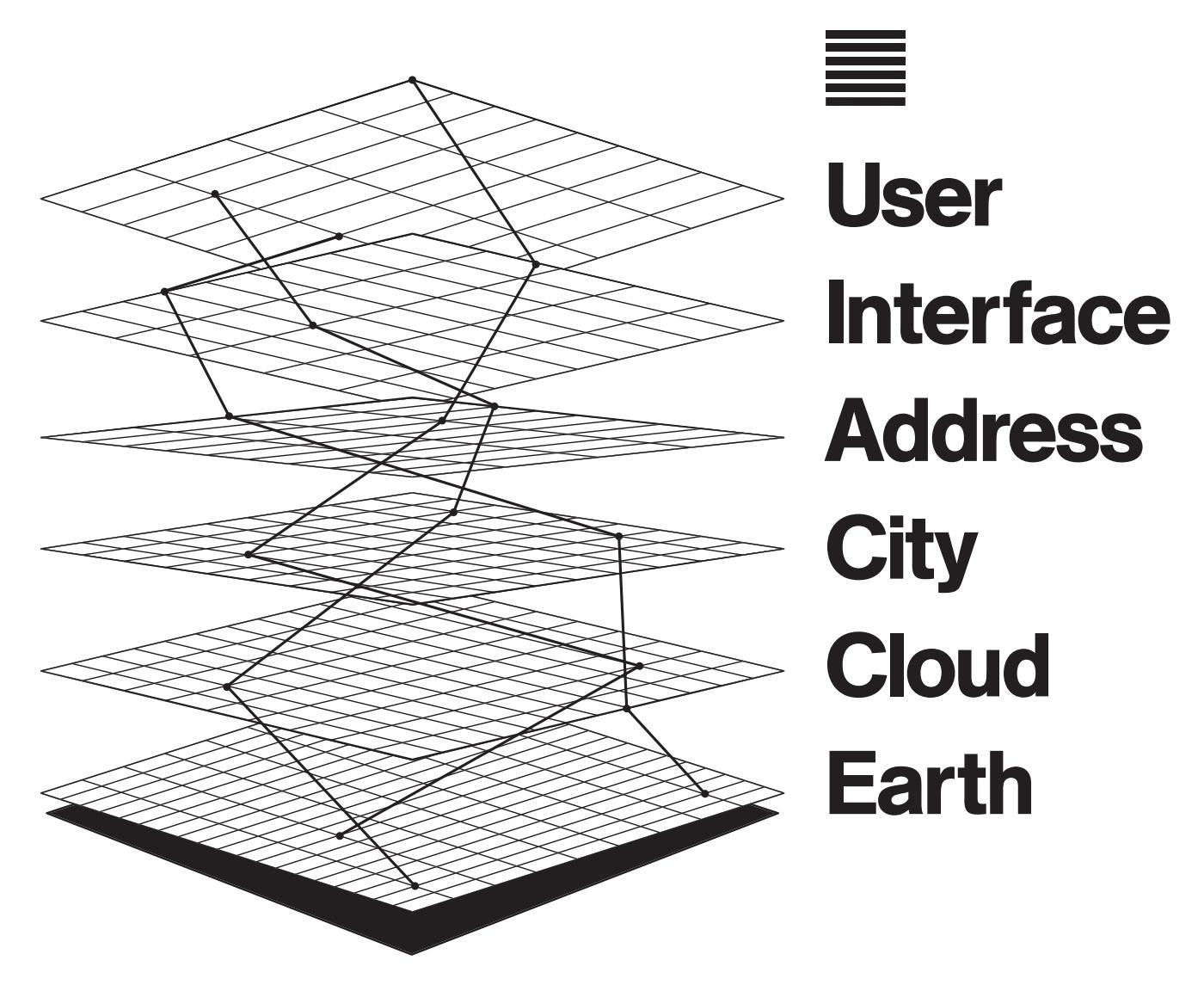
Figure 3.1 Diagram by Metahaven of the six layers of The Stack.
15. The Layers of The Stack
How does this work? What is the model exactly? The Stack is divided into six layers, moving from the global to the local, from geochemical up to the phenomenological: Earth, Cloud, City, Address, Interface, and User. For The Stack, multiple layers co-occupy the same terrestrial location (horizontally) but gather and subdivide their processes vertically into discrete machinic " jurisdictions. "That subdivisional geography is bound within the mechanism of the platform, but at the same time, The Stack platform itself disturbs existing models of jurisdiction and projects its own out into the world. Each layer configures and coheres its own specific forms of governance over what it touches, and so the difference between one layer and another is also a difference between those forms and processes. That is, the Cloud layer is defined by certain spatial and temporal demands that include what we conventionally recognize as Cloud infrastructure (e.g., data centers, fiber optics, and in-browser applications), but those demands may press on rather unlike things as well (parking spaces, medical equipment, food supply statistics). The six chapters that follow discuss each one of these layers in sequence, detailing especially how each produces its own governing logics of scale, physicality, textuality, embodiment, force, motion, stability, and, perhaps most important, how each of these logics provides productive accidents that may direct us toward unexpected design outcomes.
The diagram of The Stack in figure 3.1 shows a vertical-sectional relationship between possible positions occupying all six layers at once. It demonstrates that while positions on layers are held simultaneously, each layer governs that position semiautonomously. In the practice of real communication, any one instance of such a stack works only in combination with another, and in this pairing, the real social form of active stacks comes into focus. That structure of connection and communication is similar to OSI or TCP/IP. Connections tunnel down, across, and back up stacks, creating temporary circuit-like connections in a U-shaped trajectory. User connects to User by initiating a " message "that tunnels all the way down through the other layers to the bottom and then back up again, and so direct communication between Users activates all six layers down The Stack and then all six layers again back up The Stack. The whole of the system is invoked and activated by any one connection; the whole is " folded " into each single instance of activation, bending the universal and the particular into one another. We define any one such path taken down and up The Stack in a U-shaped trajectory as a column. For one " session, "however fleeting or stable, columns fix one User to another by linking layers to those above and below into a whole, but they allow anyone or anything that is a User to initiate (or be initiated by) as many other simultaneous columns as needed. That is, as any given column tracks up and down, there is no final instance of vertical or horizontal integration that would truly and ultimately resolve a User down to the Earth layer or Cloud layer for good. Any one User will initiate millions of different columns at different moments over time, thereby executing different combinations of nested positions. This slipperiness does not correspond well with modern logics of last-instance sovereignty and citizenship. It ' s not that there is no " there there "but rather that moment to moment, there are too many " theres "for any one sovereign geography to finally decide all the others.
At the top of any column, a User (animal, vegetable, or mineral) would occupy its own unique position and from there activate an Interface to manipulate things with particular Addresses, which are embedded in the land, sea, and air of urban surfaces on the City layer, all of which can process, store, and deliver data according to the computational capacity and legal dictates of a Cloud platform, which itself drinks from the Earth layer ' s energy reserves drawn into its data centers. Paths between layers are sutured by specific protocols for sending and receiving information to each other, up and down, that do the work of translating between unlike technologies gathered at each plateau. In this sense, each layer can then simulate and countersimulate the operations of the other (for Users, Interfaces " simulate "the instrumental capacities of the entire Stack, as the hard and soft networks of the Cloud and City are " translated " one into the other). Their interlocking adherence to standard protocols guarantees the linking of information up and down and between like layers (or even skipping layers occasionally), and for this, an external application can enter into The Stack at any level and begin to move between levels from that starting point. Any path from top to bottom is but one possible route among many others. For example, one path from Interface to Address may be very different from another from Address to City. There are any number of possible links between User to Address, Interface to Cloud, and Earth to City, or horizontally between the same layer of two stacks (i.e., City to City). The durable form of one layer, in one context, might enable or prevent variation within another layer, because different layers function with a contingent whole with greater or lesser degrees of stability or variability. For example, identical configurations on the Cloud layer of column may link very different contexts on the User layer that is necessarily more responsive to dynamic cultural nuances.
In practical terms, two different Users may make use of the same Interfaces and Addresses within the same City, but each may have very different privileges and limitations at the Cloud layer. As that may be the layer on which it is most decisively perched, a state may see what the Cloud layer can see (and not what it can ' t see) in the recursive path up and down the columns that are visible to that particular layer ' s techniques of perception and its own dispositions of looking. At the top layer, because no two Users have the same level of privilege and access within the space of possibilities in which a particular column might form, political tension pulls tight around that difference. Perhaps then the ultimate identity of any one User within The Stack could be calculated by those limitations that contrast one User to its neighbors plus the patterned aggregation of the columns it has activated over time (not unlike how today ' s commercial Cloud platforms track and model their subscribers). For any User a particular position on one layer might guarantee a corresponding position on another layer, or might disqualify it altogether; not only are layers technically interdependent, but their social effects are as well. Attention to this leverage between layers is essential because the possible designable distribution of such positions in relation to one another may also drive the contested governance of the Cloud and of any alternative geopolitics it might engender. Even so, for the Stack platform to work, each layer still reserves its own limits, rules, and concreteness that is never finally reducible to the terms and jurisdictions of another. On the one hand, the layer ' s modularity within the whole means that its effects are never exclusive or exhaustible, and on the other, the rigid simplicity of the total platform apparatus demands that its direct functions remain encapsulated. 33 Even as any one layer ' s operations unfold in relation to those of adjacent layers, and so may also affect events that fall well outside the entire platform ' s borders, the movement of hard and soft information must always pass through the protocols that divide and bind that layer ' s work from the others.
While any one layer ' s operations in a given site or moment could be captured (or guaranteed) by state, nonstate, transstate, superstate, or substate actors, all the different layers within the arc of a specific column trade on multiple and incongruous strategies, all or none of which may be codified by one legal jurisdictional vision (itself perhaps unrecognized by the jurisdiction underwriting local control of another layer). A spectrum between incongruent policing and practical interoperability nevertheless characterizes the politics of stacks and is also itself even subject to local enforcements, both inside and outside the column or layer that may be in dispute. In daily practice, specific columns (hundreds of millions of them every second) are separated from one another by their unique and particular nestings of these positions and counterpositions and by the interlocking coordination of their simultaneity, fixed or unfixed by the force of formal state description. Because the autonomy of individual layers in the platform resists total capture of the platform ' s totality, the interslicing of aggressive " little totalities "between columns might be rough or smooth, honed by the investments of happy Users or just as easily by the grinding tones of mutual resistance. For any column, any strong sovereign claim (state or nonstate) can only extend over some layers in any given moment or location, but never on the entire Stack at once. Interface and Address may be monopolized by one jurisdictional totality in one context, and Earth and City for another in another context, but absolute dominion over all six layers across contexts is doomed by the superimposition of multiple geographies at once, communicating with one another without master steerage or any one final settlement of transactions. At least in this way, The Stack is (we hope) a totality that is resistant to totalitarianism, even as its governing coherency depends on the gravitational pull of each layer and on the gathering of more and more of the world into its logistics (even making the opportunity cost of transactions and transitions too cheap to measure). In the six chapters that follow, I illustrate a provisional geopolitics of The Stack with which we work, one layer at a time and in aggregate, and speculate about a blossoming of exotic sovereignties that each layer might support or contain, in isolation from and in concert with others. The tilt is not toward how a sublime coordination of Stack technologies might hasten the arrival of some full-spectrum computational end of history, but how its gnashing juxtapositions generate peculiar new spaces, fractured enclaves, and how its newly normalized exceptions are perhaps instructive beyond their immediate scope. As said, each individual layer spits out its own possible accidents as it abuts its neighbors, and each is presented not only as a medium for design but as a technology for accidents.
First, the Earth layer provides a physical foundation for The Stack. This chapter begins by considering the agency of silica as a computational substrate and how the classical idea of a universal granularity of atomic matter has framed how we understand the physics (and metaphysics) of computation. It argues for a foregrounding of the geological substrate of computational hardware and of the geopolitics of mineral and resource flows of extraction, consumption, and discarding. 34 It examines arguments regarding the ultimate energy sourcing and routing necessary for planetary computational infrastructure and the paradoxes posed by the race to build smart grids capable of supporting its continuance and maturation. In important ways, it is possible for us to sense, quantify, and predict ecological precariousness through Stack technologies, and yet the production and feeding of those same systems are also key contributors to those same risks. The chapter concludes with a discussion of the knotty problems of ecological governance and the issues posed by turning the ecology itself into a kind of final, ambient emergency.
The Cloud layer chapter discusses the vast server archipelagoes behind the scenes and behind the surface that provide ubiquitous computational services as well as the geopolitical intrigue that involves them. It includes in this the entire infrastructural complex of server farms, massive databases, energy sources, optical cables, wireless transmission media, and distributed applications. It focuses on the conflicts arising from the juxtaposition and superimposition of state geography and cloud platforms (i.e., the Google-China conflict) and on how the evolution of states into cloud platforms extends and complicates the locations of infrastructural and legal sovereignty. The chapter also compares several existing Cloud platforms as models for alternative Cloud polities.
The City layer of The Stack comprises the environment of discontinuous megacities and meganetworks that situate human settlement and mobility in the combination of physical and virtual envelopes. These partition and subdivide access to urban space, but in their generic comprehensiveness, they may also provide for forms of accidental cosmopolitanism, ones derived not from parliamentary certificates but from a shared physical relationship to pervasive infrastructure. We also examine the urban-scale imprints of major Cloud platforms and how their physical postures and positions disclose specific geopolitical imaginaries.
Now closer to the scale of familiar objects and interactions, the Address layer examines massively granular universal addressing systems such as IPv6 (Internet Protocol version six) (including cryptographically generated hash addresses), which would allow for a truly abyssal volume of individual addressees. Such individuated addresses make any thing or event appear to the Cloud as a communicable entity, and for The Stack, computation then becomes a potential property of addressed objects, places, and events, and a medium through which any of these can directly interact with any other. While scenarios for ubiquitous computing and an " Internet of Things "suggest information exchange between " smart "natural objects, what I refer to as " deep address, "is interested in communication between very different spatial and temporal scales, absorbing any addressable " haecceity "into vast, if also fragile, communicative fields that may exceed the limits of conventional control or literacy.
The Interface layer describes the projective, perceptual cinematic, semiotic layer on a given instrumental landscape, including the frames, subtitles, navigable maps, pixelated hallucinations, and augmented realities through which local signification and significance are programmed. Interfaces provide imagistic and linguistic mediation between Users and the Addressable computational capacities of their habitats, priming the pump for possible communication. The chapter outlines a typological history of interfaces, from the mechanical, to the semiolinguistic, to the haptic and gestural. As an interface, any surface or gateway oscillates between open and closed in a given context, and because of this, it is where the reversibility of the interior/exterior decision by platforms is most clearly observed. As an interactive diagram, GUIs present a visually coherent image of otherwise discontiguous and opaque logistical flows, but when aligned with new interface technologies, such as augmented reality that superimposes interfacial elements directly into the perceptual field, they can collapse a metaphorical space between object and interpretation. This literal projection of the ideas and ideologies of an imagined community onto perceived objects and events can engender undesirable cognitive fundamentalisms.
At the top of The Stack is the most culturally complex layer, the User. This chapter describes how The Stack sees the humans and nonhumans that initiate columns up and down its layers, from Interface to Earth and back again, As a contemporary image of self, the User is asked to speak through utilitarian scripts, and yet its subjectivity is also opened up to unexpected kinds of universality. Human and nonhuman Users are positioned by The Stack (perhaps rudely) as comparable and even interchangeable through a wide-ranging and omnivorous quantification of their behaviors and effects. The preponderance of data generated by Users and the traces of their worldly transactions initially overtrace the outline of a given User (e.g., the hyperindividualism of the quantified self movement), but as new data streams overlap over it and through it, the coherent position of the User dissolves through its overdetermination by external relations and networks. The User' s enumeration is first a grotesquely individuated selfimage, a profile, but as the same process is oversubscribed by data that trace all the things that affect the User, now included in the profile, the persona that first promises coherency and closure brings an explosion and liquefaction of self.
The concluding chapter draws out from these discussions some of the most tangled and complex implications of The Stack as geopolitical design challenges to be achieved or resisted. Among these is the proliferation of enclaves as a political and architectural expression of network geographies. As each layer is considered in relation to its accidents, The Stack itself is the composite accident that may define the course of geopolitics to come. As a global platform, its demand for universality and totality should be read in both utopian and dystopian registers equally. The Stack may represent an epochal enclosure of the planet under an absolutist regime of algorithmic capital, or the fragility of its totality may force new breaks as its infrastructural universality spawns new, even emancipatory programs of disenchantment, discovery, and design. The design brief begins on the cliff ' s edge of the Anthropocene, and tilts toward an acceleration into risk and reward; it presumes that the megainfrastructures of " actually existing "algorithmic capitalism are not, as of now, able to break clear of their own failures and realize a break for and toward the latent potential of a postscarcity geoeconomics. That acceleration is not therefore an acceleration of The Stack or away from its risks, but toward a particular termination and succession, and toward the articulation and realization of a more genuinely luxurious social geology. We are resigned that the emergence of that planetary condition, wherever and whenever, will likely not include or require human geopolitics as we currently understand it. As such, we commit to the ongoing design of the accidental megastructure knowing full well that its ultimate purpose may be to disappear before it fully arrives.